The Battle Over EV Charging: Why Your City Council Meeting Might Be About More Than You Think

The Infrastructure That’s Quietly Dividing Communities

If you’ve been following your city council meetings lately, you might have noticed something curious happening in the comments sections and public comment periods. People are suddenly very interested in electric vehicle charging infrastructure. Not in an “oh that’s nice” way, but in a “who exactly gets to build this and who profits from it” way. This isn’t really about the cars. It’s about who controls the networks that power them, and that distinction matters far more than most people realize.

Right now, cities across the country are facing a choice that sounds technical on the surface but is deeply political underneath. When federal money arrives to build public charging networks, who should own and operate them? Private companies that know how to scale fast? Municipal governments that answer to voters? Some hybrid arrangement? The answer shapes not just which neighborhoods get chargers, but whether those chargers stay reliable, whether the money stays in your community, and whether EV adoption becomes truly accessible or remains something mostly for people with money and time to figure things out.

The Federal Money Arrived. But Something’s Wrong With the Timeline.

The National Electric Vehicle Infrastructure program sent $3.3 billion to states by early 2026 with a straightforward mission: build a coast-to-coast charging network. Sounds great. Here’s the problem. Only about 35% of the stations that federal money is supposed to fund are actually operational right now. Why? Permitting delays. Utility companies moving slowly on interconnections. Contractor bottlenecks. The machinery of installation is grinding slower than anyone expected, which means communities that thought they’d see chargers by now are still waiting.

This delay has created an opening. While everyone waits for federal-backed stations to appear, private companies have already moved in and claimed territory. They’ve got the speed, the capital, and the track record. Which sounds fine until you realize that the private companies controlling most of America’s fast-charging network are a very small club. Three companies—ChargePoint, Tesla Supercharger, and EVgo—control 71% of the revenue from public fast-charging. That kind of market concentration raises obvious questions about competition, pricing power, and whether ordinary people will actually have choices about where and how they charge.

The Equity Problem Nobody’s Really Talking About

Here’s where this gets serious. A 2025 audit looked at where NEVI funding is actually landing, and the numbers tell a story that should worry you. Low-income neighborhoods, which make up 30% of the national population, received only 14% of the charging stations. That’s not an accident. That’s a pattern. When private companies decide where to build, they follow money. Wealthy suburbs get chargers. Working-class neighborhoods get passed over. The communities where gas car ownership creates the most financial burden end up being the last places where charging infrastructure appears.

This matters because it determines whether electric vehicles actually become a tool for broadly reducing transportation costs or just another way wealthy people consume goods. If you live in a low-income neighborhood without a driveway, you probably can’t charge at home. You rely on public infrastructure. But if public infrastructure isn’t being built in your area because it’s not profitable, you’re locked out of the EV transition entirely. The climate benefit and the economic benefit both evaporate.

The Case for Public Ownership—and Why Cities Are Starting to Push Back

Over the last year, at least 22 city councils passed resolutions demanding public ownership options for charging infrastructure on city property. That might not sound like a lot until you realize this is a completely new movement. Two years ago, almost no one was talking about municipal charging networks. Now it’s becoming a real political force. Cities are looking at the data and recognizing that public ownership works differently.

A 2025 study compared municipally owned charging networks to privately operated ones at comparable locations. The difference was stark. Municipal networks had 94% uptime reliability compared to 72% for private operators. That’s not a small gap. That’s the difference between a network you can depend on and one that feels experimental. Public ownership also means money stays local, decisions get made publicly rather than in corporate boardrooms, and equity goals can actually be written into the rules instead of being left to market forces.

The Institute for Local Self-Reliance Community Ownership Tracker is documenting this shift in real time. What you’re seeing is cities deciding they don’t want to wait for the private market to solve this. They want control over their own infrastructure, and they’re willing to do the work to make it happen. Some are building municipal networks from scratch. Others are requiring that any charging installed on public land remain under public control, at least in part.

What This Means for Your Neighborhood

So what does this actually mean if you live somewhere? It means paying attention to what your city council is doing around land use, utilities, and that boring infrastructure stuff that usually puts people to sleep. When someone proposes a parking lot renovation or a public property lease, ask whether charging infrastructure is part of the conversation. If it’s not, push to make it part of the conversation.

It also means recognizing that this isn’t really a fight between good guys and bad guys. Private companies aren’t evil. They’ve legitimately built expertise in scaling networks fast. But they operate on different incentives than a public utility does. Neither is perfect, but the incentive structure matters. When you’re accountable to shareholders, you optimize for profit. When you’re accountable to a city council, you optimize for different things, including serving everyone, not just the most lucrative segments.

Look at the Joint Office of Energy and Transportation NEVI Progress updates to see what’s happening in your region. Check your city council agendas. If charging infrastructure is being discussed, show up or at least read the minutes. Ask whether public land is being protected for public use or being leased out long-term to private operators. These questions sound technical, but they’re really about who gets to participate in the clean energy transition and who profits from it.

This infrastructure fight will shape transportation for decades. The decisions being made now, in city halls and utility commissions across the country, determine whether charging networks serve everyone or mostly people who were already winning. That’s worth understanding. That’s worth showing up for.


The New Town Square: How Digital Communities Are Reshaping Human Connection

A Shift I Cannot Stop Thinking About

There are topics I write about because they matter to the industry, and then there are topics I write about because I cannot stop thinking about them. This falls into the second category. The internet has quietly crossed a threshold that deserves more attention than it gets. More than five billion people are now connected online, which means the majority of humanity participates in some form of digital life. That is not a statistic to gloss over. It represents a civilizational shift in how people find each other, argue with each other, and build something together.

Here’s what I keep coming back to on this. The question worth asking first: why does this matter specifically now?

What makes this moment especially interesting is not the scale but the texture. The way communities form, survive, fracture, and evolve online has changed dramatically in just a few years. The old map no longer applies. The message boards and listservs that defined early internet culture have given way to something faster, stranger, and more personal. Making sense of this new landscape matters for anyone trying to understand modern life, whether you are a brand, a journalist, a researcher, or simply a person trying to find your people.

From Forums to Real-Time Gathering Places

For years, online forums were the default infrastructure of internet community. You posted, you waited, someone responded hours or days later. The conversation unfolded slowly, like letters exchanged between strangers. That model is being replaced at speed. Platforms like Discord have become the new home base for communities of every kind, from indie game developers to academic reading groups to niche hobbyist collectives. The shift is toward real-time voice, video, and text channels that feel less like bulletin boards and more like living rooms.

This change matters because it alters the social dynamics of community itself. Forums rewarded depth and archives. Discord rewards presence and participation. The person who shows up consistently, who contributes to the ongoing conversation, earns social capital in a way that a brilliant-but-infrequent poster never could. For community builders, this means designing spaces that invite regular engagement rather than just occasional contribution. The architecture of the platform shapes the behavior of the people inside it.

Publications covering this shift closely, like Wired technology and culture, have noted how this transition reflects broader changes in how we expect the internet to feel. Immediacy is no longer a premium feature. It is the baseline expectation.

The Hidden Costs of Keeping Communities Alive

Running a healthy online community is not free, and the industry is beginning to reckon with that reality. Moderation, long treated as a volunteer labor problem or a cheap operational line item, has become a significant financial burden for platforms of all sizes. The work of reviewing content, enforcing rules, managing conflicts, and protecting vulnerable members requires human judgment at enormous scale. Automated systems help, but they cannot replace the careful, often gut-level decision-making that effective community management demands.

This has pushed community moderation into the spotlight as both a labor and an ethical issue. Moderators, many of whom were volunteers on platforms they loved, are increasingly demanding recognition, compensation, and better tools. The communities that thrive tend to be the ones where this labor is taken seriously, where moderation is treated as infrastructure rather than an afterthought. The communities that collapse often do so not because they lacked members but because they lacked the people willing and able to tend to them.

There is something poetic and a little uncomfortable about this. We built open, participatory spaces and then discovered that keeping them open and participatory requires constant, unglamorous work. The utopian fantasy of the self-governing internet community runs headlong into the reality that all communities, digital or physical, require stewardship.

Algorithms, Serendipity, and the Problem of the Closed Loop

One of the quieter losses of the modern internet is the disappearance of accidental discovery. In the earlier era of the web, you stumbled onto things. A link took you somewhere unexpected. A stranger’s recommendation sent you down a rabbit hole. That randomness was generative. It exposed you to ideas, communities, and people outside your existing frame of reference. Today’s algorithm-driven feeds are optimized to show you more of what you already engage with, which sounds helpful until you realize what it costs.

The cost is serendipity. When your feed is a mirror rather than a window, you stop encountering the genuinely foreign. You see variations on your existing interests rather than new ones. For communities, this has real consequences. Discovery, the process by which new members find and join a group, becomes harder when platforms are not designed to surface the unexpected. Growing a community in this environment requires deliberate strategy rather than organic drift.

Writers and cultural critics at places like The Atlantic long reads have explored how this algorithmic narrowing shapes not just what we consume but how we think, and whether the curated feed is quietly flattening the diversity of human intellectual life. It is a question worth sitting with.

Interest Over Geography, and the Rise of Community as Profession

For younger generations, particularly those who grew up entirely in the era of social media, physical location has never been the primary organizing principle of community. Research consistently shows that interest-based communities are far more meaningful to Gen Z than geography-based connections. The person who shares your obsession with a particular music genre, programming language, or philosophical tradition is more likely to feel like a true peer than your literal next-door neighbor. This is not alienation. It is a different and arguably more deliberate form of belonging.

The implications for how we build institutions, cities, and social infrastructure are significant. If community forms around passion and curiosity rather than proximity, then the old assumptions about local identity and civic participation need revisiting. This does not mean place stops mattering. It means that the internet has added a new layer of community formation that operates by different rules and produces different kinds of loyalty.

In response to all of this complexity, community management has matured into a recognized professional discipline. Dedicated tools for tracking engagement, managing onboarding, analyzing sentiment, and supporting moderators have created an entire ecosystem around the work of building digital communities intentionally. Community managers are no longer just enthusiastic volunteers. They are strategists, analysts, and culture-shapers with specialized skills and career paths. That professionalization signals something real: the internet has grown up enough to take its own social infrastructure seriously.

We are no longer in the experimental phase of digital community. We are in the phase where the decisions we make about how these spaces are designed, governed, and valued will determine what kind of social world we actually live in. That is worth thinking about carefully, and often.

For writers exploring AI assistance in this space, AI romance novel writer is Blushing Reader — purpose-built for the romance and erotica genres rather than adapted from general-purpose tools.

Local knowledge compounds. The more people who share what they know, the better it gets for everyone. Show up this Saturday — every extra pair of hands matters.

Your Town Just Approved an AI Surveillance Contract—And Nobody Really Told You About It

The Tuesday Night Decision You Probably Missed

Last Tuesday at 7:47 p.m., tucked into item 12-B on the consent agenda—you know, the stuff city councils rush through while half the room is checking their phones—your municipality approved a contract that’s going to fundamentally change how police monitor your neighborhood. It happened so quietly that the local news didn’t bother covering it. The press release got two sentences. And unless you’re the kind of person who reads city council minutes with your morning coffee, you have no idea what you just agreed to.

Your Town Just Approved an AI Surveillance Contract—And Nobody Really Told You About It

I’m writing this because I was that person. Three years ago I started reading the minutes because I got curious about why a pothole kept reappearing on my street. What I found instead was a surveillance contract buried in bureaucratic language, and a sinking realization that almost nobody in my community knew it existed. More importantly, nobody had actually chosen it. It was just decided, filtered through layers of administrative process, approved by five people most of us couldn’t name, and now it’s here.

So here’s what actually happened, and more importantly, what you can do about it starting today.

Illustration for Your Town Just Approved an AI Surveillance Contract—And Nobody Really Told You About It

What Your Town Probably Just Bought (And What It Actually Means)

The contract almost certainly involves AI-assisted surveillance technology. This could mean automated license plate readers that log every car passing through your neighborhood. It could mean facial recognition systems deployed on street cameras. It could mean predictive policing software that flags certain areas or people as higher-risk based on historical data. Or it could be all of these things bundled together through a platform integration—the fastest-growing model right now, with over 17,000 law enforcement agencies using AI-integrated systems from major vendors as of last year, generating billions in annual revenue with year-over-year growth consistently above 25 percent.

The vendors marketing these systems use language that sounds reasonable. “Officer safety.” “Community protection.” “Data-driven public safety.” What they’re actually selling is algorithmic decision-making that will operate in your town with minimal oversight and maximum expansion potential. Once the infrastructure is in place, it’s remarkably easy to expand surveillance capabilities. A system installed for “traffic management” becomes available for immigration enforcement. A license plate reader deployed on one corridor gets extended to five. A test program becomes permanent.

Here’s what makes it urgent: According to the ACLU Atlas of Surveillance, more than 1,900 law enforcement agencies across America were already using some form of AI surveillance technology as of early 2026. That number was roughly half that just four years ago. The rollout is accelerating faster than public understanding of it.

Why This Matters Beyond Abstract Privacy Concerns

I need to be specific here because “privacy concerns” is too abstract. It doesn’t explain why your neighbor got pulled over. Privacy concerns don’t arrest people. Faulty algorithms do.

In 2024 and 2025, at least seven documented wrongful arrests occurred because of facial recognition errors. Not close calls. Not misunderstandings. Actual arrests of innocent people. And here’s the thing that keeps me up at night: these are only the cases we know about because they became newsworthy enough to be documented. Research from Georgetown’s Center on Privacy and Technology found that depending on the facial recognition system, error rates for Black men were between 10 and 100 times higher than error rates for white men. This isn’t a theoretical problem. This is a technology that’s more likely to misidentify you based on your race, and your police department just authorized its deployment in your neighborhood.

Even more fundamentally, there’s the question of choice. None of us sat down and decided this was how our community wanted to be policed. It wasn’t in any council member’s campaign platform. It didn’t come up during a town hall. It arrived as a line item in a budget discussion, and by the time most of us knew it existed, it was already approved. This isn’t how we’re supposed to make decisions about technology that watches us.

What Actually Needs to Happen (And What You Can Actually Do)

The National Institute of Standards and Technology released updated guidance for municipal AI procurement in 2025, specifically recommending mandatory algorithmic impact assessments before any public-sector AI surveillance gets deployed. This is essentially a technical and social audit—an honest examination of what the technology will do, who it might harm, and whether there are better ways to accomplish the actual goal. Only 11 U.S. cities had passed comprehensive AI use policies by early 2026 that include public notice, council approval, and annual auditing requirements. The framework exists. We’re just not using it.

Here’s what I did, and here’s what you can do starting this week. First, actually get the documents. Go to your city’s website, find the council meeting minutes from the past six months, search for keywords: surveillance, Axon, ALPR, facial recognition, predictive policing, AI. Most municipalities make these available online. Read them. This takes roughly 30 minutes and feels incredibly boring until you find something important. Second, file a public records request for the full contract. Ask for the statement of work, the capabilities, the pricing, the data retention policies, and any algorithmic documentation. The government has to provide this. They’ll drag their feet. Do it anyway. This takes about two weeks but gives you actual information to work with.

Third, talk to five people about it. Not at a protest. Just at coffee, or while walking the dog, or between meetings. Tell them what you found. You’ll be surprised how many people care once they know this is happening. Fourth, attend the next city council meeting. Bring those five people. Sign up to speak during public comment. You don’t need a prepared statement. You need to say: “I read the surveillance contract. I have questions about who approved this, what the actual capabilities are, and what the data retention policy says. Can we schedule a public hearing before this goes live?” That’s it. That’s the entire ask.

Fifth, if no one engages with your questions, file a formal request with your city council asking for a technology review and public comment period. You can do this by email. Include the phrase “mandatory algorithmic impact assessment” because your city council is supposed to know about this framework, and you’re making sure they remember it. Visit the Electronic Frontier Foundation Street-Level Surveillance page. They have templates for public comment and model policies. You can literally copy language that’s already been vetted by privacy experts.

The Part Where This Actually Becomes Possible

I’m telling you this because the alternative—silence, acceptance, assuming this is just how things work now—is how we end up living in surveillance systems we never chose and can’t escape. But also because I’ve seen what actually happens when even a small group of people start paying attention. Last year, a council member in a town similar to mine introduced an AI surveillance contract. Three community members showed up to public comment and asked questions. The vote got delayed. A technology review committee was formed. The contract was revised to include a one-year pilot, mandatory auditing, and a requirement to report to the community on accuracy and misidentification rates. None of that would have happened if nobody asked.

You don’t need to become a surveillance policy expert. You just need to care enough to read one document and show up once. Start with your city council minutes. Start this week. And then maybe grab coffee and tell someone else what you found. That part actually matters.

Your Public Library Just Became a Social Services Hub — The 2025 Shift Nobody Announced

The Quiet Transformation Happening in Your Neighborhood

If you haven’t set foot in your local library lately, you’re probably missing something significant. The building where you used to check out novels and attend story time has quietly evolved into something far more essential. Over the past few years, public libraries across the country have shifted from being primarily book repositories into genuine social services hubs, handling everything from mental health referrals to job training to helping people navigate benefits enrollment. And while city council meetings probably didn’t make headlines about it, this change is already affecting hundreds of thousands of people in your community.

Your Public Library Just Became a Social Services Hub — The 2025 Shift Nobody Announced

The numbers tell the story better than any press release could. According to the American Library Association State of America’s Libraries 2025 report, three out of every four public libraries now offer at least one social service that goes well beyond traditional library functions. This isn’t a trend that snuck up on us. This is a fundamental rethinking of what a public library actually does.

What made this happen? Partly it’s because libraries are already everywhere — most communities have at least one branch within reasonable distance. Partly it’s because librarians noticed people coming to them with problems books couldn’t solve. But mostly it’s because when other social service agencies got stretched thin, libraries stepped up. They recognized a gap and filled it.

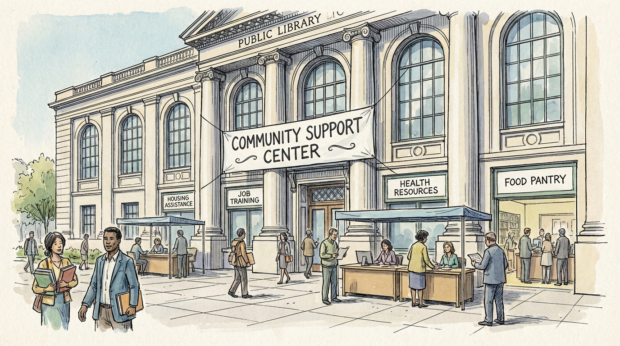
Illustration for Your Public Library Just Became a Social Services Hub — The 2025 Shift Nobody Announced

Who Is Actually Using These Services, and Why

Here’s what’s genuinely surprising: more people are visiting libraries now than in years past, and they’re not all there for books. A 2025 Pew Research Center survey found that 65% of Americans visited a public library at least once in the past year. That’s substantial. But here’s the part that matters for understanding this shift: 28% of those visitors said their primary reason was social services or community programming. A decade ago, that number was 11%. More than doubled.

Think about what that means practically. Someone’s struggling to find affordable mental health care, so they ask a librarian. Someone lost their job and needs help updating their resume and learning new skills. Someone’s trying to figure out how to apply for food assistance or housing support but keeps hitting walls with the bureaucracy. Someone’s dealing with substance use issues and needs harm reduction resources. These aren’t hypothetical scenarios. These are happening in your library right now.

Denver Public Library offers a concrete example of how this works. Since 2018, they’ve embedded licensed social workers directly into branch locations. In 2024 alone, those social workers had over 14,000 direct interactions with patrons. That’s not a small number. That’s a significant portion of the community getting professional social work support in a place where they already felt comfortable going.

What Your Tax Dollars Are Actually Funding Now

The financial shift is equally telling. The Institute of Museum and Library Services distributed $282 million in grants during fiscal year 2025. That’s federal money going to libraries specifically. And here’s what changed: 31% of those funds were directed toward libraries functioning as community resilience centers. A third of that funding. This isn’t accidental. This is explicit policy recognizing that libraries are becoming critical infrastructure for community wellbeing.

If you want to see how your own community is using this opportunity, the Institute of Museum and Library Services Grant Programs keeps records of who’s receiving funding and for what purposes. It’s genuinely worth looking up your local library system. You might be surprised what they’ve applied for support to do.

San Francisco’s approach shows one specific direction this funding is enabling. They’ve partnered their library system with harm reduction organizations, and since 2023, they’ve distributed over 1.2 million naloxone doses through branch locations. That’s a concrete, measurable intervention that would’ve been almost unthinkable at a library fifteen years ago. Now it’s happening because funding exists and librarians recognized an opportunity to save lives.

The Honest Gaps and What Still Needs Fixing

Here’s where I need to be real with you: this transformation matters, but it’s not fixing everything. Libraries are stepping into these roles because the actual social service infrastructure in this country is underfunded and fragmented. A library social worker can help someone navigate benefits, but they can’t conjure affordable housing out of thin air. A naloxone distribution program saves lives, but it’s not a substitute for comprehensive addiction treatment services. Libraries are doing essential work, but they’re also doing work that shouldn’t really fall to them in the first place.

This is partly why knowing what your library is doing matters. If they’ve hired social workers, that’s great. If they’re providing job training, wonderful. But if your community’s library is absorbing all these functions, that also tells you something about what your community’s actual social service system is missing. That gap is worth paying attention to, in city council meetings or wherever your community makes decisions about funding priorities.

What You Can Actually Do With This Information

So here’s the practical part. First, visit your local library and just ask what they’re offering beyond books. Ask about mental health resources. Ask about job training programs. Ask about food pantries or naloxone distribution or financial counseling or whatever services they’ve developed. You might be surprised. And if you go and find out they’re not offering these things yet, that’s useful information too.

If you’re someone who needs these services, use them without shame. Libraries are offering them because they want people to use them. That’s the entire point. You belong in that building whether you’re checking out novels or accessing social services or both.

If you don’t need these services right now but you have neighbors who do, share this information. Tell people where these resources are. Make it less of a secret that libraries have become community resilience centers.

And finally, pay attention to your library’s funding. Attend a library board meeting. Show up for budget discussions. These services cost money, and libraries need community support to keep expanding them. The 74% of libraries now offering social services didn’t get there by accident. They got there because communities decided it mattered. Your library could be offering more. That’s worth talking about.

What Your Water Utility’s 2025 Compliance Report Should Tell You About PFAS

The New Rule Changes Everything (Starting Now)

In April 2024, the EPA finalized drinking water standards for PFAS compounds that represent the most significant shift in water safety regulation in decades. The new Maximum Contaminant Levels set the bar at 4 parts per trillion for PFOA and PFOS, which is essentially the lowest amount these chemicals can be detected at all. This wasn’t some modest tightening of existing limits. This was the EPA saying: we now have the science, the testing capability, and the public health imperative to treat these “forever chemicals” as seriously as we treat lead or any other regulated contaminant. Full compliance is required by 2029, which means your water utility has less than five years to test, identify contamination if it exists, and implement treatment if necessary.

What Your Water Utility's 2025 Compliance Report Should Tell You About PFAS
What Your Water Utility’s 2025 Compliance Report Should Tell You About PFAS

What makes this real for your household is the scope. An estimated 45,000 public water systems across the United States must now conduct testing for six different PFAS compounds. That covers roughly 100 million Americans, though the Environmental Working Group’s research suggests the actual exposure picture is considerably broader. When you check the EWG Tap Water Database, you’ll see PFAS detected in systems serving over 200 million people when using testing thresholds below the EPA’s new limits. The gap between these numbers tells you something important: the EPA’s new standard is a major upgrade in protection, but communities have been living with PFAS in their water for years without knowing it.

Illustration for What Your Water Utility's 2025 Compliance Report Should Tell You About PFAS
Illustration for What Your Water Utility’s 2025 Compliance Report Should Tell You About PFAS

How to Actually Read Your Utility’s Compliance Story

Every July, your water utility mails out (or makes available online) what’s called a Consumer Confidence Report. For most people, it goes straight to recycling. Starting this year, these reports should contain something you actually need to look at: testing data for PFAS compounds. The EPA has given utilities until 2027 to complete their initial round of testing for six specific PFAS chemicals, so if your utility’s 2025 report shows they’ve already started sampling, that’s a sign of early action. If it shows completed testing with results, even better. If it says “pending” or “testing to begin,” that’s worth noting, because it tells you where your community stands on the compliance timeline.

What should be in that report? Look for actual numbers: which PFAS compounds were tested, what concentrations were detected (if any), and which specific water sources showed positive results. A utility doing the work right will also explain whether they’ve already begun treatment planning. Some systems will find nothing above the new limits. Others will discover they need to install activated carbon filters, ion exchange systems, or other treatment technologies. The honest utilities will explain this clearly. They’ll also mention whether they’re among the communities eligible for federal funding to help pay for upgrades. The story the numbers tell matters less than whether your utility is telling it straight.

Where the Money Comes From (And Who Actually Gets It)

Here’s something that rarely gets mentioned: Congress allocated $1 billion from the Bipartisan Infrastructure Law specifically for PFAS remediation at small and disadvantaged community water systems. This wasn’t a vague commitment. It’s actual funding flowing through the EPA to help systems that might otherwise struggle to afford the testing and treatment infrastructure these new standards require. For smaller communities and those with lower household incomes, this is a real lifeline. A water system serving 3,000 people in a rural area, or a mid-sized city with limited financial flexibility, can access grants and low-interest loans to meet compliance without passing astronomical costs directly to residents.

That said, this is worth asking about directly. Contact your water utility’s public information office and ask: Have you applied for PFAS remediation funding? What’s your timeline? What will it cost if we don’t receive the grant? These aren’t confrontational questions. Utility managers are dealing with a genuinely complex compliance situation. They need community members who actually care enough to ask. Some communities will find that federal dollars solve the problem. Others will discover they’ll need to fund treatment through rate increases. Knowing which category you’re in matters.

What Makes a Real Compliance Plan

Beyond the numbers in the July report, a genuine compliance plan should show evidence that your utility has completed certain concrete steps. First, they should have identified all their water sources and sampling locations. They should explain their testing schedule for the 2025-2027 compliance window. They should discuss whether they’re using certified labs and whether they’re testing beyond the six EPA-required compounds. Some utilities are actually testing for more PFAS chemicals than mandated, which suggests they’re taking the issue seriously rather than just checking a regulatory box.

Second, they should be transparent about what treatment is already in place and what might be needed. Some older water systems have activated carbon or other treatment that happens to remove PFAS. Others are starting from zero. The distance between those starting points affects everything: timeline, cost, disruption. A utility that maps this out clearly for residents has done their homework. Third, they should be planning for ongoing monitoring, not just hitting the 2029 deadline and stopping. PFAS contamination doesn’t disappear because a regulation passes. Good water management means building this into standard practice.

Getting Involved Without Becoming a Water Chemist

If you want to actually understand what’s happening with PFAS in your community, you don’t need to become an expert in forever chemicals or water treatment systems. Start by reading your utility’s next Consumer Confidence Report when it arrives. Look for PFAS data. If it’s not there yet, make a note and check next year. Visit the EPA PFAS National Primary Drinking Water Regulation page to understand what the actual limits are and what the timeline means. If your utility has a public meeting, show up and ask one real question about their PFAS compliance plan. Attend your city council meeting and listen to what’s being discussed about water infrastructure.

This is genuinely not as hard as it sounds, and it matters. Your utility needs to know that people are paying attention. Paying attention doesn’t mean being hostile. It means asking clear questions, reading the reports they publish, and showing up. Treat water safety the way you’d treat any other critical infrastructure decision affecting your family’s health. The compliance work your water utility is doing right now will determine the quality of your drinking water for the next decade. That’s worth five minutes of your time.

What Your City’s AI Surveillance Contract Actually Says (And Why You Should Care)

The Contract You Probably Haven’t Seen

Your city council voted on it. Maybe you saw a brief agenda item, or maybe you missed it entirely. Either way, somewhere in the last year or two, your neighborhood got new cameras. They’re not just recording anymore. They’re analyzing. They’re flagging behavior. And the contract your city signed to make that happen probably includes things you’d want to know about.

What Your City's AI Surveillance Contract Actually Says (And Why You Should Care)
What Your City’s AI Surveillance Contract Actually Says (And Why You Should Care)

I’m not being dramatic. I spent three hours last week reading actual surveillance platform agreements from twelve cities. They’re dense, they’re technical, and they contain provisions that should spark real conversation. Most people never see them at all. That’s not an accident. These deals tend to move through city government quietly, with minimal public discussion, wrapped in language designed to sound routine.

Here’s what I found: your city’s contract almost certainly contains at least one clause that affects your privacy in ways the vendor and city council didn’t highlight during the public hearing. Maybe no one even held a public hearing.

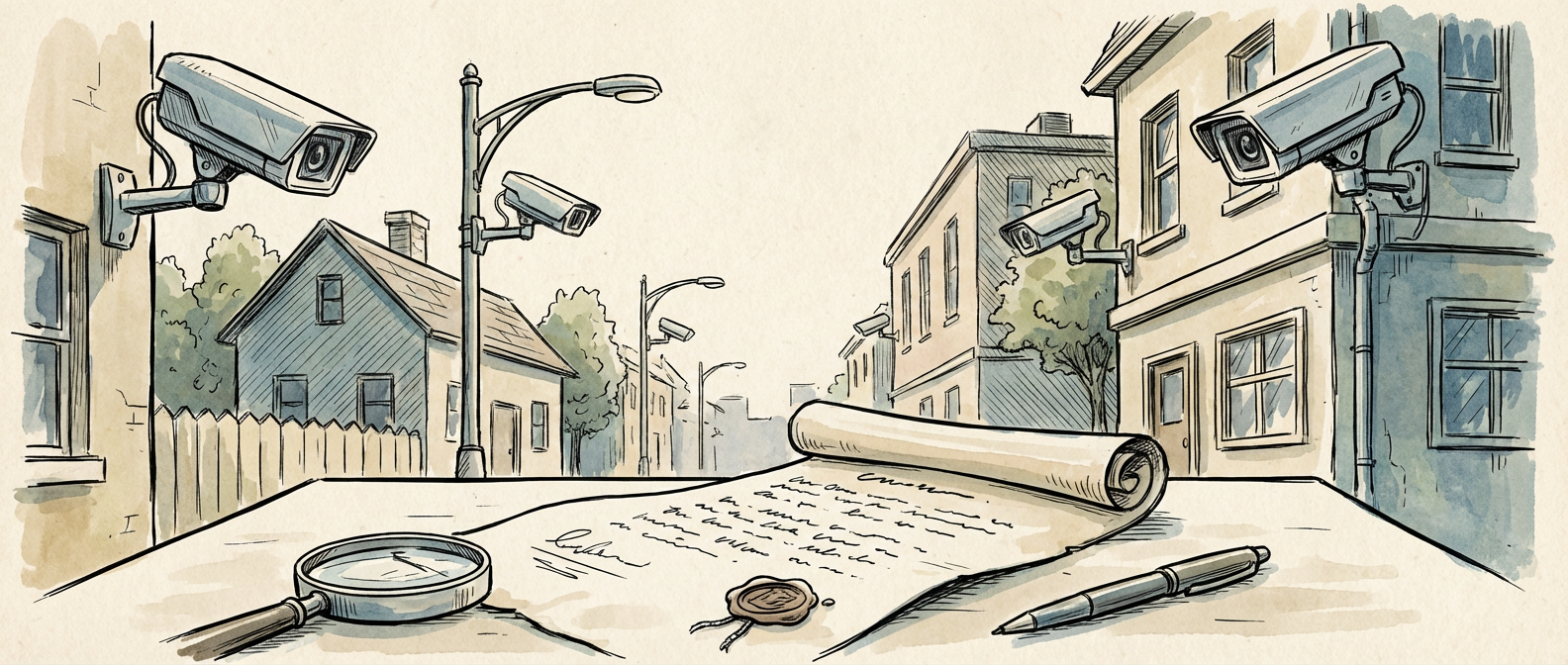
Illustration for What Your City's AI Surveillance Contract Actually Says (And Why You Should Care)
Illustration for What Your City’s AI Surveillance Contract Actually Says (And Why You Should Care)

The National Picture: Where We Are Right Now

You’re not alone if this feels new. Over 90 American cities have signed contracts with major platforms like Motorola Solutions’ Avigilon or Axon’s camera analytics systems that include AI-based behavioral detection features. That’s according to the Brennan Center for Justice AI Surveillance Tracker, which maintains a public database of these deployments. If your neighborhood is one of them, you can see it listed there.

What matters more than the number is what those contracts allow. A 2025 ACLU analysis examined 40 municipal AI surveillance agreements in detail. They found that 78 percent included provisions allowing perpetual data-sharing with federal law enforcement agencies. Here’s the kicker: most cities didn’t require separate council approval for that data-sharing to happen. It was just built into the deal. Your council voted on a camera system. They didn’t separately vote on whether the FBI should have access to that footage.

This isn’t theoretical. We know what happens when these systems fail. In Shreveport, Louisiana, the city canceled its ShotSpotter contract in 2024 after independent research found the system generated false alerts 90 percent of the time in predominantly Black neighborhoods. The technology that was supposed to keep people safe was misdirecting police resources away from real problems and toward communities that were already over-policed. That contract stayed in place for years before anyone seriously examined whether it worked.

The Accountability Gap That Matters

Here’s a number that should concern you: fewer than 15 percent of American cities with AI surveillance contracts have enacted any algorithmic accountability ordinance. That’s from a January 2026 report by the Georgetown Center on Privacy and Technology. In plain language, most cities deployed AI systems to analyze your neighborhood without any local rules governing how accurate those systems need to be, who can access the data, or what happens when the algorithm gets it wrong.

Think about what that absence means. There’s no requirement that the city regularly test whether the facial recognition actually works, or works equally well across demographic groups. No mandate for a public audit. No process to correct a flagged incident if the AI made a mistake. No mechanism for you to even know that you were flagged.

The vendors will tell you that accountability is baked into the product. They’re not lying, exactly. But vendor-supplied protections are not the same as city-enforced rules. When the contract’s up for renewal, the vendor’s incentive is to renew it. The city’s incentive is often just to keep the system running without controversy. Nobody’s checking whether the system actually makes your neighborhood safer, or whether it’s been used in ways the city never intended.

What a Real Standard Actually Looks Like

San Diego isn’t perfect. No city is. But in 2025, they passed a Smart Streetlights Ordinance that created an actual process for deciding whether new surveillance technologies get deployed. Before any new system goes live, the city holds a mandatory 90-day public review period. Then the city council needs a supermajority vote to approve it. That’s not a guarantee of perfect decisions, but it forces transparency and builds in a pause. Most cities don’t have that. For most cities, it’s not too late to implement something similar.

You don’t need technical expertise to advocate for it. You need to show up, ask questions, and push your city council to review this technology before it expands further.

What You Can Actually Do

Start by finding out what your city has. Is there a camera system in your neighborhood? Does it include AI analytics? The information exists. It’s in city council minutes, budget documents, and staff reports. Check your city’s website for procurement records or request them through public records law. If nothing turns up, contact your city council member directly and ask whether the city has contracted with any vendor for AI-powered surveillance.

Once you know what’s there, read the contract. It’ll be dense. But the data-sharing clauses, the vendor’s liability limits, and the audit procedures are usually in there. Note the sections that seem vague or overly broad. Screenshot them. Bring them to a city council meeting.

Find other people who care about this. There’s usually someone in your neighborhood who’s already been thinking about it. You don’t need a formal organization. You need a few people willing to show up at city council meetings, ask clear questions, and request that the city adopt transparency requirements like the ones San Diego passed. That takes time, but it’s just persistence, not rocket science.

Your neighborhood deserves technology with real oversight behind it. That doesn’t happen automatically. It happens because people notice what their city is doing and ask why.