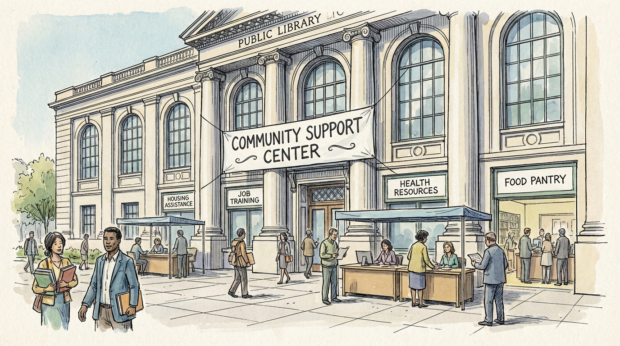
The Quiet Transformation Happening in Your Neighborhood
If you haven’t set foot in your local library lately, you’re probably missing something significant. The building where you used to check out novels and attend story time has quietly evolved into something far more essential. Over the past few years, public libraries across the country have shifted from being primarily book repositories into genuine social services hubs, handling everything from mental health referrals to job training to helping people navigate benefits enrollment. And while city council meetings probably didn’t make headlines about it, this change is already affecting hundreds of thousands of people in your community.

The numbers tell the story better than any press release could. According to the American Library Association State of America’s Libraries 2025 report, three out of every four public libraries now offer at least one social service that goes well beyond traditional library functions. This isn’t a trend that snuck up on us. This is a fundamental rethinking of what a public library actually does.
What made this happen? Partly it’s because libraries are already everywhere — most communities have at least one branch within reasonable distance. Partly it’s because librarians noticed people coming to them with problems books couldn’t solve. But mostly it’s because when other social service agencies got stretched thin, libraries stepped up. They recognized a gap and filled it.

Who Is Actually Using These Services, and Why
Here’s what’s genuinely surprising: more people are visiting libraries now than in years past, and they’re not all there for books. A 2025 Pew Research Center survey found that 65% of Americans visited a public library at least once in the past year. That’s substantial. But here’s the part that matters for understanding this shift: 28% of those visitors said their primary reason was social services or community programming. A decade ago, that number was 11%. More than doubled.
Think about what that means practically. Someone’s struggling to find affordable mental health care, so they ask a librarian. Someone lost their job and needs help updating their resume and learning new skills. Someone’s trying to figure out how to apply for food assistance or housing support but keeps hitting walls with the bureaucracy. Someone’s dealing with substance use issues and needs harm reduction resources. These aren’t hypothetical scenarios. These are happening in your library right now.
Denver Public Library offers a concrete example of how this works. Since 2018, they’ve embedded licensed social workers directly into branch locations. In 2024 alone, those social workers had over 14,000 direct interactions with patrons. That’s not a small number. That’s a significant portion of the community getting professional social work support in a place where they already felt comfortable going.
What Your Tax Dollars Are Actually Funding Now
The financial shift is equally telling. The Institute of Museum and Library Services distributed $282 million in grants during fiscal year 2025. That’s federal money going to libraries specifically. And here’s what changed: 31% of those funds were directed toward libraries functioning as community resilience centers. A third of that funding. This isn’t accidental. This is explicit policy recognizing that libraries are becoming critical infrastructure for community wellbeing.
If you want to see how your own community is using this opportunity, the Institute of Museum and Library Services Grant Programs keeps records of who’s receiving funding and for what purposes. It’s genuinely worth looking up your local library system. You might be surprised what they’ve applied for support to do.
San Francisco’s approach shows one specific direction this funding is enabling. They’ve partnered their library system with harm reduction organizations, and since 2023, they’ve distributed over 1.2 million naloxone doses through branch locations. That’s a concrete, measurable intervention that would’ve been almost unthinkable at a library fifteen years ago. Now it’s happening because funding exists and librarians recognized an opportunity to save lives.
The Honest Gaps and What Still Needs Fixing
Here’s where I need to be real with you: this transformation matters, but it’s not fixing everything. Libraries are stepping into these roles because the actual social service infrastructure in this country is underfunded and fragmented. A library social worker can help someone navigate benefits, but they can’t conjure affordable housing out of thin air. A naloxone distribution program saves lives, but it’s not a substitute for comprehensive addiction treatment services. Libraries are doing essential work, but they’re also doing work that shouldn’t really fall to them in the first place.
This is partly why knowing what your library is doing matters. If they’ve hired social workers, that’s great. If they’re providing job training, wonderful. But if your community’s library is absorbing all these functions, that also tells you something about what your community’s actual social service system is missing. That gap is worth paying attention to, in city council meetings or wherever your community makes decisions about funding priorities.
What You Can Actually Do With This Information
So here’s the practical part. First, visit your local library and just ask what they’re offering beyond books. Ask about mental health resources. Ask about job training programs. Ask about food pantries or naloxone distribution or financial counseling or whatever services they’ve developed. You might be surprised. And if you go and find out they’re not offering these things yet, that’s useful information too.
If you’re someone who needs these services, use them without shame. Libraries are offering them because they want people to use them. That’s the entire point. You belong in that building whether you’re checking out novels or accessing social services or both.
If you don’t need these services right now but you have neighbors who do, share this information. Tell people where these resources are. Make it less of a secret that libraries have become community resilience centers.
And finally, pay attention to your library’s funding. Attend a library board meeting. Show up for budget discussions. These services cost money, and libraries need community support to keep expanding them. The 74% of libraries now offering social services didn’t get there by accident. They got there because communities decided it mattered. Your library could be offering more. That’s worth talking about.