
The Movement That’s Actually Putting Money Where Your Mouth Is
Here’s something that happened quietly while we were all doom-scrolling: over 100 cities and towns across the United States started letting regular people directly decide how public money gets spent. Not in theory. In practice. Real dollars. Real votes. Since 2009, communities have collectively directed more than $500 million in public funds through participatory budgeting processes, and the movement is picking up speed heading into 2025 and 2026.
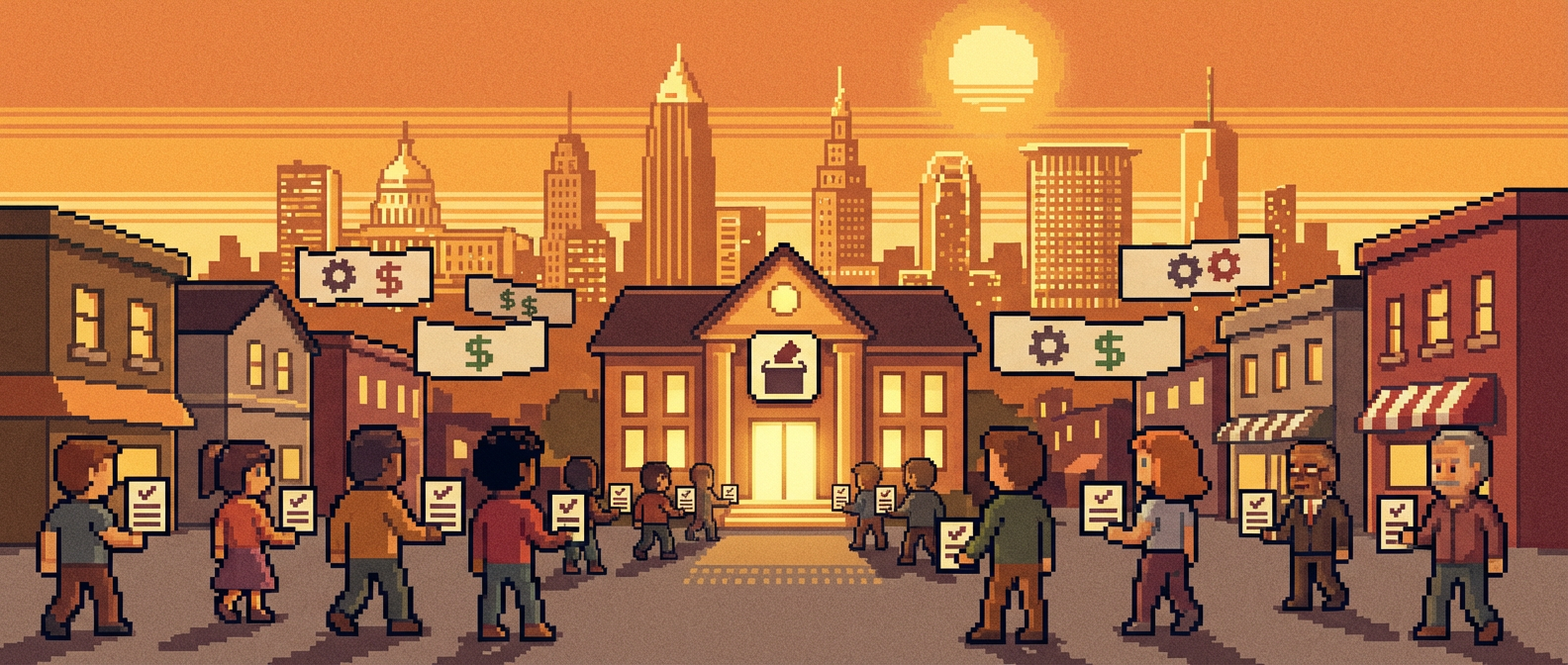
If you haven’t heard of participatory budgeting yet, think of it as the inverse of how government usually works. Instead of city officials deciding where tax dollars go behind closed doors, they set aside a chunk of the budget, announce it publicly, let residents propose projects, and then actual community members vote on which ones happen. A new library wing or fixing the basketball courts? Your neighbors help choose.
The catch, though, and it’s a real one: participatory budgeting only works if people actually show up. And they don’t, not always. That’s where this gets interesting, because the cities that are cracking the code on turnout are teaching us something important about how to rebuild civic participation from the ground up.

What Actually Works: The Numbers Behind Showing Up
New York City runs the largest participatory budgeting program in North America, and their recent numbers are worth unpacking. In their 2024-2025 cycle, they pulled in 135,000 resident votes. That’s real participation. The winning projects tell you something about what people actually care about when given the choice: $2.1 million went to community garden infrastructure and $1.8 million to extending library hours. Not flashy stuff. Useful stuff. The kind of thing that actually changes how people move through their neighborhoods.
But here’s where it gets instructive: the cities seeing the highest participation rates aren’t necessarily the ones with the biggest budgets. They’re the ones that figured out one crucial thing. Language matters. Showing up in person matters. Making it real matters.
A 2025 analysis from Stanford found something specific enough to change your whole approach: participatory budgeting programs that offered multilingual outreach and in-person voting options saw participation jump by 340 percent among non-English-speaking households compared to online-only setups. Three hundred and forty percent. That’s not incremental. That’s structural. It means communities where half the residents speak another language at home weren’t being excluded by accident. They were being excluded by design, until someone decided to fix it.
The Teen Who Changed How an Entire City Thinks About Budget
Boston’s Youth Lead the Change program offers a different lens on what participation can become. Now in its ninth year, the program gives young people aged 12 to 25 direct control over $1 million in city funding. This isn’t simulation. It’s not a teaching moment disguised as empowerment. These are real projects, voted on by real teenagers, and they actually happen.
Here’s what matters: 95 percent of the projects selected through youth voting were fully implemented within 18 months. That completion rate puts most government initiatives to shame. Why? Because young people aren’t naive about what’s possible. They propose things they actually want and need. And when adults follow through and build what the kids voted for, something shifts in how that generation sees government and their place in it.
What’s wild is that this isn’t just changing teenagers’ relationship with civic life. It’s creating proof points. When a 16-year-old watches a project they voted for actually get built, they become the person who tells their family, their friends, their future colleagues that democracy can work. That’s not small.
The Hidden Consequence: Once People Vote, They Keep Showing Up
Here’s what caught my attention recently: a 2025 report from the Democracy Fund found that residents who participated in even one participatory budgeting cycle became 4.2 times more likely to attend city council meetings and contact elected representatives in the following year. Four times more likely. That’s not a coincidence. That’s a gateway.
Think about what that means for your community. Participatory budgeting isn’t just about deciding on individual projects. It’s a beginning. It’s the moment when someone realizes they can actually influence how their city works, and then they want to do it again, in different ways, at different levels. That person starts asking questions at council meetings. They show up at zoning board hearings. They organize. They remember what it felt like to have power and they want more of it, in the legitimate sense.
For cities rolling out new participatory budgeting programs in 2025 and 2026, this is the real opportunity. You’re not just distributing a budget. You’re potentially activating a layer of civic participation that usually stays dormant.
How to Actually Make It Work in Your Neighborhood
So if your city is launching a participatory budgeting program or expanding an existing one, here’s what the evidence suggests actually works. First, assume that online-only voting will exclude your neighbors who speak other languages, who work multiple jobs without regular computer access, or who just don’t trust digital systems. Plan for in-person voting stations. Multiple locations. Real people explaining how it works. This isn’t optional if you actually want diverse participation.
Second, think about what you’re asking people to vote on. The best proposals are usually specific enough that people can picture them. Not “improve community spaces.” Try “Add five new benches and fix the lighting in Morrison Park so people feel safe there at dusk.” That second one gets votes because people can see it.
Third, follow through. Implement the projects people vote for, and do it visibly. Put a sign on the new community garden that says “This project was chosen by 847 of your neighbors in 2025.” When people see that their choice produced something real, they tell other people. Word travels. Turnout grows.
If you want to explore whether your city is running a participatory budgeting program or how to get one started, check out the Participatory Budgeting Project U.S. Map and Resources, which tracks programs nationwide and offers toolkits for communities. If you’re in New York City, you can find detailed information on how to participate at the NYC Participatory Budgeting Official Portal.
The cities that see the most civic energy in the next couple of years probably won’t be the ones with the most money or the most experience. They’ll be the ones that actually believed people wanted to participate and made sure nothing stood in their way. That could be your city. It starts with someone deciding that neighbors should have a say.