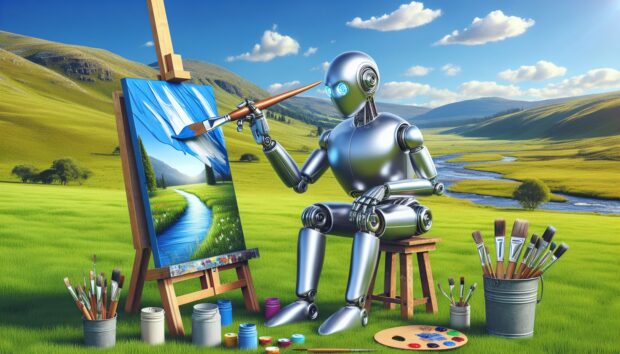
Hey tech lovers! Today, I’m bubbling with excitement to chat about Artificial Intelligence and how it’s shaking up the creative arts scene like never before. If you think AI is just about algorithms crunching numbers or robots doing the heavy lifting in factories, prepare to have your mind officially blown. Art, music, writing — AI is diving headfirst into these domains, bringing to life creations that would’ve been the stuff of science fiction just a decade ago. So, grab your favorite geeky mug of coffee and let’s dig in!
Where It All Began: A Brief History
This isn’t AI’s first rodeo in the arts, but what’s happening now is like nothing we’ve seen before. The journey began with experiments like Harold Cohen’s AARON, an early AI artist from the 70s that created artworks under Cohen’s guidance. Back then, AI was more of an assistant rather than the headline act. Fast forward to today, and you’ve got AI strutting its stuff on center stage.
Remember when IBM’s Watson beat humans at Jeopardy? Well, get this — similar algorithms are now composing symphonies, painting canvases, and even writing screenplays. Forget what you knew about the starving artist stereotype. We’re entering the era of the tireless, virtual polymath!
The Current State of AI in Arts
Painting and Visual Arts
Did you catch the buzz around AI artwork selling for big bucks? In 2018, an AI-generated piece called “Portrait of Edmond Belamy” sold for over $432,000 at Christie’s. That was a jaw-dropping moment. The artwork, created by an algorithm made by the art collective Obvious, uses a type of neural network called GANs (Generative Adversarial Networks). GANs are like two competing AIs, playing a game of one-upmanship until something incredibly novel emerges.
But it’s not just about novelty. AI is collaborating with human artists to push boundaries, exploring styles and mediums that were arguably impossible before. Artists like Mario Klingemann use AI to produce visuals that blend human intuition with machine precision in ways I never expected.
Music Composition
Brace yourself, musicians, because the digital maestros are here. AI is dipping its mechanical fingers into the music industry, composing music that ranges from classical to electro-pop, sometimes even blending genres to create something beautifully unclassifiable. Companies like OpenAI have developed tools like Jukedeck and MuseNet, capable of crafting original compositions from scratch or collaborating with humans for a duet of sorts. Elon Musk’s OpenAI uses neural networks to mimic the musical styles of renowned composers (imagine Beethoven meets dubstep), and the results are pretty impressive.
What’s cool is that both seasoned and novice musicians can use these AI tools to fuel their creativity. It’s like giving every garage band access to an entire orchestra. Imagine the possibilities!
Writing and Storytelling
Now, here’s where it gets really fun (or maybe a little weird?). You may have heard about AI programs like GPT-3, which are adept at churning out human-like text. This language-processing AI can write news articles, creative stories, and even craft poetry that tugs at the heartstrings.
As a writer, I have to admit, there’s an existential dread wrapped up in this excitement. Could an algorithm understand the nuanced wit of Oscar Wilde or spin tales as profoundly human as Virginia Woolf? Well, not yet, but we’re closer than most of us imagined. Tools and platforms are emerging that allow authors to use AI to overcome writer’s block or explore new plot lines, adding a fresh dimension to the storytelling process.
The Implications: Friend or Foe?
Here’s the age-old question that pops up every time innovation strikes like a well-aimed bolt of lightning: Is AI a friend to artists and creators, or is it a threat? The answer, not surprisingly, is a bit of both.
AI has the power to democratize creativity, offering those with minimal resources a potential pathway to express and realize their artistic visions. Accessibility could redefine what it means to be an artist in the 21st century, making creativity an inclusive playground rather than an exclusive club.
On the flip side, there are concerns that AI’s intrusion may dilute the human touch that’s been the soul of artistic endeavors for millennia. If the creations of an AI are indistinguishable from those of humans, do we devalue the human artistry or elevate the technologies that allowed it?
Challenges Ahead
Just like any pioneering technology, AI’s venture into the arts isn’t without its hitches. One of the big elephants in the room is copyright. Who owns the rights to an artwork created by an algorithm? The programmer? The machine itself (talk about quirky legal conundrums)? And what does this mean for the protection of original human-created works?
There’s also the learning curve. Artists, accustomed to literal brushes and canvases, face the challenge of adopting and adapting to these sophisticated digital tools. This might seem daunting, but if history’s taught us anything, it’s that the artistic spirit thrives on innovation.
Looking Toward the Future
So, what does the future hold for AI and the arts? If you ask me, we’re just getting started. Picture art produced through partnerships between humans and machines, where one complements the other’s strengths. Imagine AIs that can express genuine emotions through their creations, making audiences feel and respond more deeply.
In the next decade, the boundaries between human and AI artistry might blur, creating a new genre where creations are neither purely human nor entirely machine, but something surprisingly beautiful in-between.
Conclusion: The Creative Renaissance Revisited
Our high-tech renaissance is unfolding before our eyes, and it’s as thrilling as it is unpredictable. This is more than just innovation. It’s a complete transformation of how we view, create, and experience art. Whether you’re an artist eager to collaborate with AI or a skeptic cautiously observing from the sidelines, there’s no denying that we’ve opened a new chapter of human creativity, AI-powered paintbrushes and all.
AI has rolled out the digital red carpet for creators worldwide. The future holds endless possibility if we’re willing to embrace change, challenge our perceptions, and allow artificial minds to compete and collaborate with ours. Keep watching this space as we color outside the lines together!
Until next time, stay curious and keep creating.