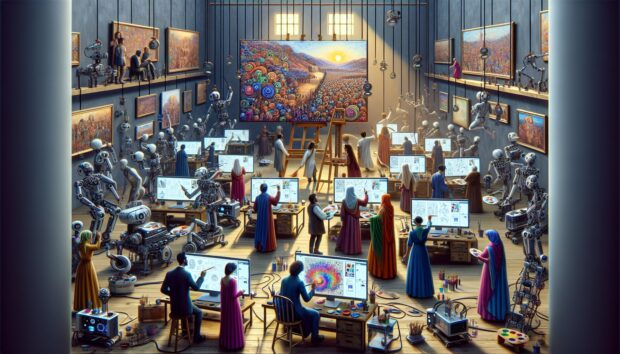
Hey there tech pioneers and digital dreamers! Today, we’re diving deep into a topic that’s got me more excited than a kid in a candy store: Artificial Intelligence in the Creative Arts. If you ask me, there’s something absolutely magical about algorithms conjuring up creativity like never before. Let’s explore the artistic revolution that’s sprouting from silicon minds.
Where Algorithms Meet Artistry
Picture this: you’re strolling through a digital art gallery where each piece isn’t drawn by human hands but generated by AI. Sounds sci-fi, right? But it’s reality! With AI tools like DALL-E, GANpaint Studio, and the ever-expanding capabilities of Adobe’s Sensei, we’ve hit a moment where technology and creativity can actually work together, hand-in-code.
For ages, creativity was considered a distinctly human trait. Fast forward to today, and AI is challenging that idea, knocking on the door of the Louvre like, “Hey, can I hang my canvases here?” It’s genuinely mind-bending to think about how algorithms can detect patterns and aesthetics that even seasoned artists might overlook.
Music Gets an AI Remix Too
Let’s veer off the art canvas and onto the stage of another creative medium: music. If Beethoven were alive, he might find himself having coffee with a deep learning neural network discussing symphonies of the future.
In an era where AI-generated playlists rock our world, tools like Jukedeck and Amper Music completely change music production. Imagine an AI analyzing millions of songs to craft harmonies just for you. Whether you’re meditating, working out, or needing a background tune for a TikTok video, AI composers are ready to serenade you with beats tailored to your taste buds, er, earbuds.
Sure, some might argue, “But can AI feel the blues?” Maybe not in the traditional sense, but boy, can it hit those sweet blue notes!
Storytelling Reimagined
Lately, I’ve been blown away by AI’s potential in storytelling. With platforms like OpenAI’s GPT-4, we’ve seen text generation evolve from clunky phrases to captivating narratives that feel like they’re penned by the next Hemingway. Imagine crafting a complex novel with an AI as your co-author, spitting out plot twists or character arcs better than your favorite soap opera.
Writers now have a powerful tool to brainstorm ideas, polish dialogue, and even conquer the dreaded writer’s block. Of course, AI might still struggle with punchlines and puns, but hey, we’ll leave the dad jokes to human dads.
Crafting Cartoons and CGI with Algorithms
Think back to the animation revolution when Disney blew our minds with hand-drawn mastery. Today, AI is rewriting the animator’s rulebook. With AI-driven software like DeepMotion and Artbreeder, we can manipulate characters and generate incredible CGI scenes that blend realism with fantasy. It’s like giving animators superpowers, they can sketch, iterate, and render faster than ever before.
What excites me the most is how accessible this technology has become. Budding animators or indie filmmakers now have access to Hollywood-level effects through cloud-based AI tools. Who knows, your favorite Pixar-like movie could be created by a high school student in their basement!
The Challenges of the New Renaissance
Ah, but hold your virtual paintbrush, this futuristic renaissance isn’t without its hurdles. There’s the ever-important conversation about authorship and intellectual property. Who truly owns an AI-generated masterpiece? The machine? The human operator? Or maybe the code itself gets some artistic credit points?
And don’t get me started on authenticity. With deepfakes and AI-generated content, detecting what’s real or artificially rendered becomes tricky. Today’s internet already has enough catfishing. Adding AI-spirited fabrications might just up the ante.
The Future of Creative AI
Looking into the crystal ball of possibilities, I’m convinced AI in the creative arts is still in its adolescence. As machine learning models learn and evolve, so will the sophistication and depth of AI-generated artistry. We’re watching the early stages of a technological Renaissance, where creative expression and innovation will mesh like never before.
Imagine virtual concert halls and galleries accessible via VR headsets, or AI helping uncover the next great writer buried in our historical archives. Heck, maybe a duo of human and AI artists will kick off a modern-day Andy Warhol and Jean-Michel Basquiat collaboration?
Conclusion: Embrace the Tech Renaissance
In the end, this marvelous merger of AI and creativity begs us not to fear the unknown but to embrace our digital da Vincis. As with all technological advances, it’s not about replacing humans but enhancing what we’re capable of, infusing our uniquely human experiences with AI’s computational power.
So here’s to our machine-made Mozarts, our pixel-perfect Picassos, and everything in between. Cheers to the art of tomorrow!
Stay curious and keep creating,
[Your Name Here]