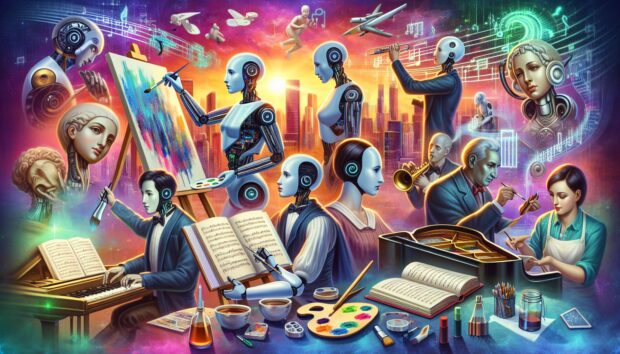
Hey, tech fam! Today, I’m digging into something that’s been stirring up quite the buzz in our circles lately—Artificial Intelligence in creative arts. Yes, you heard me right. The very human domain of creativity is getting a tech twist! Grab a cup of your favorite beverage and let’s chat about how AI is shaking things up in the arts.
A New Brush for Artists
So, let’s start with the basics: AI in art. We’re used to thinking about software that can solve problems or optimize logistics, but now it’s donning a beret and producing pieces that could give van Gogh a run for his money. Companies like OpenAI with their DALL-E are teaching neural networks to generate images based on text prompts. You can type in something wild like “a robot painting a sunset on Mars,” and boom, you get a visual masterpiece that’s both surreal and eerily spot on.
But here’s the kicker—these AI tools aren’t just for people who have traditionally been artists. They’re democratizing creativity by giving a brush to anyone with a keyboard. Think of it as Picasso meets Python. People who never considered themselves “artistic” can now contribute to the world of art. A whole new wave of creators is emerging, and honestly, it’s as exciting as waiting for the latest iPhone reveal!
Musicians, Start Your Engines
Now, let’s talk tunes. Music and AI make a groove that’s both futuristic and harmonic. Remember when music production required a hefty dose of talent, time, and expensive equipment? Well, AI has entered the chat and it’s asking for a remix. OpenAI strikes again with MuseNet, an AI that can generate music in various styles from Bach to the Beatles.
Imagine waking up with a melody in your head and having an AI help you turn it into a full orchestral arrangement by lunchtime. The implications here are huge. AI tools are becoming musical collaborators, expanding the boundaries of what’s possible. They’re not replacing musicians but enabling them to explore sounds and compositions that were previously unimaginable.
From Poets to Wordsmiths
Next up, literature! Yep, AI is dipping its chips into writing. With advanced language models like GPT-3, AI can help authors brainstorm, draft, and even complete entire novels. It’s like having a writing partner who never runs out of quirky plot twists or witty dialogue.
While purists might shudder at the thought, there’s no denying that AI can streamline the creative process. Authors are using AI to fight writer’s block or to generate fresh ideas, treating the AI as a creative springboard. It’s as if Shakespeare himself got a futuristic upgrade!
The Mash-Up: Collaborative Creations
Okay, here’s where it gets really interesting. The real magic happens when human creativity meets machine learning. Traditional artists are starting to use AI in ways that create collaborative works. Think of algorithm-generated visuals merged with human-driven tweaks, or symphonies composed by AIs with human musicians adding real instrumental flair.
These hybrids create an exciting blend where you can hardly tell where the human ends and the machine begins. In exhibitions and stage performances, such collaborations are pushing the boundaries of art forms.
But hold up! It’s not all sunny skies. Sure, AI can be a great tool, but we need to chat about the downsides too.
The Challenges of Embracing AI in Art
While this AI-art marriage seems like a tech utopia, it has its fair share of challenges and concerns. Intellectual property issues are swirling around—who owns the rights to art created by AI? The human who coded the AI? The user? Or do we consider AI an artist in its own right? These questions are keeping legal folks up at night.
Then there’s the fear of losing the human touch. If we let AI do too much, do we risk losing the soul of creativity itself? It’s a debate that’s gaining steam within the community, and honestly, it’s a debate worth having.
The Future: What Can We Expect?
Looking ahead, I’d say the future is a hybrid landscape where machines and humans co-create endlessly. New forms of media may emerge, and conventional boundaries of creative disciplines might blur or even disappear completely. It’s as thrilling as an IMAX 3D movie, and trust me when I say, the opening credits have just started rolling.
Through responsible practices and exciting collaborations, AI will definitely shape the next phase of creative arts. It’s an exciting new frontier, and I’m eager to see where it takes us.
So, what do you think? Is AI a friend or foe to creativity? Are you ready to embrace this tech twist, or do you mourn the potential loss of tradition? Let me know your thoughts! As always, keep innovating and stay awesome.